
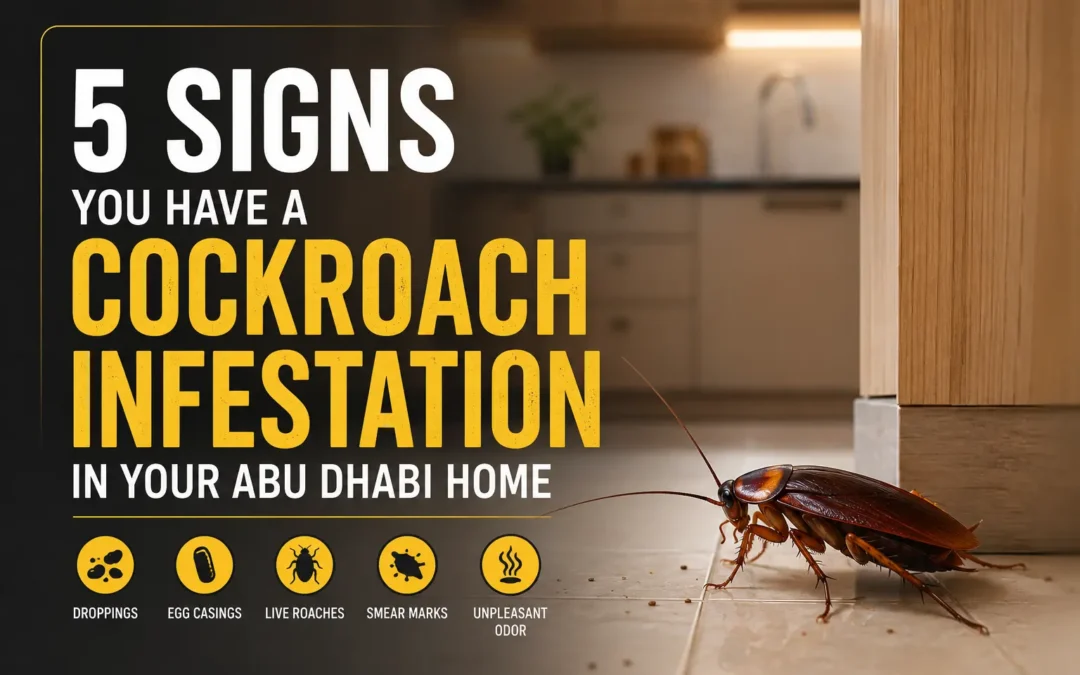
Finding a single cockroach in your Abu Dhabi home is not the same as having an infestation. Cockroaches are opportunistic — one can enter your property through a drain, a bag of groceries, or a gap under a door without any others being present. The critical question is: are you looking at a solitary intruder, or at the visible tip of a much larger population living inside your walls, under your appliances, and inside your cabinets?
The answer matters enormously. A single cockroach can be dealt with quickly and cheaply. An established infestation — where a breeding colony has taken hold inside your property — requires professional treatment and is almost impossible to eliminate with over-the-counter products alone.
This guide explains the five specific signs that tell you, definitively, that you have a cockroach infestation in your Abu Dhabi home — not just a passing visitor. Each sign includes what to look for, why it indicates an infestation rather than a single insect, and what you should do about it immediately.
Why Abu Dhabi Homes Are Particularly Vulnerable to Cockroach Infestation
Before the signs, it is worth understanding why cockroach infestations in Abu Dhabi properties develop faster and persist longer than in many other parts of the world — because it changes how seriously you should take each of the signs below.
Abu Dhabi’s year-round heat provides the ideal temperature range for cockroach reproduction. The German cockroach — the most common species found inside Abu Dhabi kitchens — reproduces fastest at temperatures between 25°C and 33°C. With Abu Dhabi maintaining indoor temperatures in exactly this range for most of the year through air conditioning, cockroaches have a permanent breeding environment inside your property regardless of the outdoor season.
The city’s water infrastructure — shared drainage systems in apartment buildings, the proximity of properties to older sewer networks in established areas like Khalidiyah and Al Karama, and the condensation that forms around AC drainage pipes — creates the moisture conditions that cockroaches need to survive and thrive.
Abu Dhabi’s dense residential developments also mean that cockroach populations can spread between connected properties through shared walls, pipe chases, drainage, and utility corridors — making individual property treatment less effective without addressing the wider building context.
The 4 Cockroach Species Found in Abu Dhabi Homes
Knowing which species you are dealing with affects both the signs you will find and the treatment required. The table below covers the four cockroach species most commonly encountered in Abu Dhabi residential properties:
|
Species |
Size |
Most Common Location |
Infestation Speed |
|
German Cockroach (Blattella germanica) |
10–15 mm |
Kitchens, behind appliances, cabinet hinges |
Very fast — 40 eggs per case, 4–6 cases per female |
|
American Cockroach (Periplaneta americana) |
35–40 mm |
Drains, sewers, basements, utility rooms |
Moderate — but spreads between floors via pipes |
|
Oriental Cockroach (Blatta orientalis) |
20–25 mm |
Damp areas, under sinks, external drains |
Moderate — prefers cool and dark areas |
|
Brown-Banded Cockroach (Supella longipalpa) |
10–14 mm |
Bedrooms, living rooms, electrical equipment |
Moderate — unique in spreading beyond kitchen areas |
Sign 1: Cockroach Droppings — The Clearest Evidence
Cockroach droppings are the single most reliable indicator of an established infestation — and in Abu Dhabi homes, they appear in very specific locations. German cockroach droppings look like small black or dark brown specks, roughly 1 to 2mm in size, resembling ground coffee or black pepper. American cockroach droppings are larger — cylindrical, approximately 3 to 4mm, with ridged sides.
Where to look: The areas where Abu Dhabi residents most commonly find cockroach droppings are the inside corners of kitchen cabinets (particularly the hinges and back corners where cockroaches hide during the day), behind the refrigerator and oven, inside the motor area underneath the refrigerator, along the back wall of under-sink cabinets, and inside electrical appliances that generate heat — toasters, microwaves, and kettles.
Why this confirms an infestation rather than a single cockroach: A single cockroach produces a relatively small amount of droppings. Visible accumulations of droppings — enough to notice when you open a cabinet or pull out an appliance — indicate a population that has been feeding and defecating in your property for weeks or months. The volume of droppings gives you a rough indication of infestation size: a light dusting suggests a small population; a significant accumulation covering cabinet surfaces or appliance interiors suggests a large, established colony.
In Abu Dhabi properties, the under-sink cabinet and the area behind and beneath the refrigerator are the two locations where cockroach droppings are found first in 80 percent of residential infestations. Check these areas with a flashlight if you suspect a problem.