
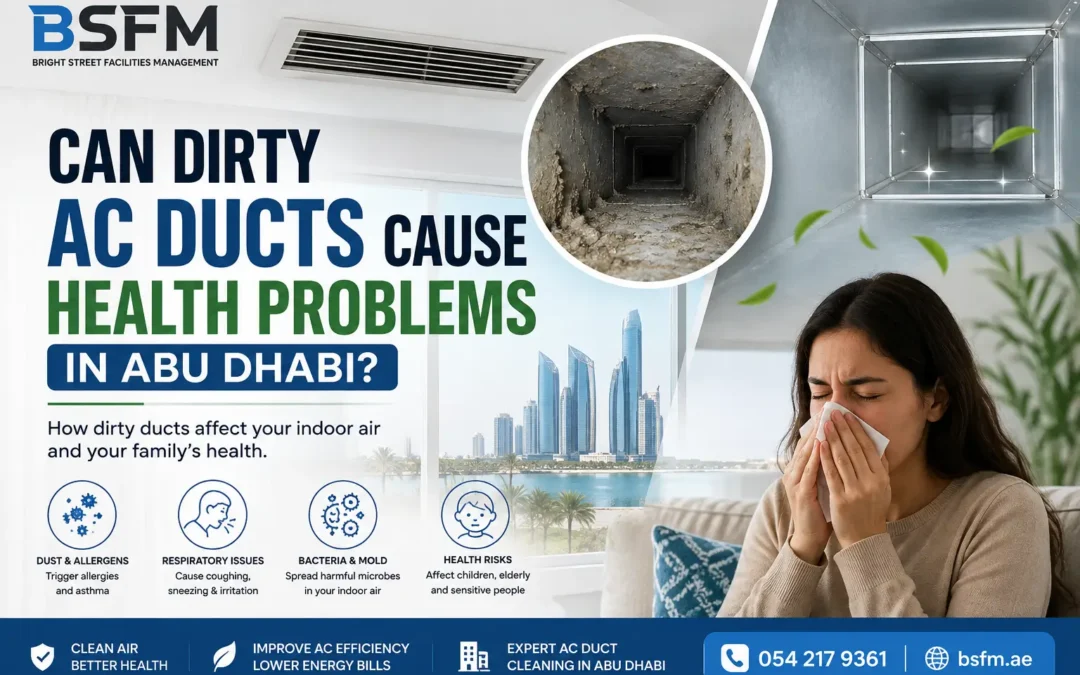
The short answer is yes, and the evidence is more significant than most Abu Dhabi residents realize.
In Abu Dhabi, air conditioning isn’t a seasonal comfort; it’s a year-round necessity. Studies on indoor living patterns in hot climates consistently find that residents spend the vast majority of their day indoors during peak heat months, which means the air circulating through your AC duct system is effectively the air you breathe for most of every day, every month of the year. When that duct system is contaminated with dust, sand, mold spores, bacteria, and allergens, the health consequences are direct and measurable. This article explains what dirty AC ducts actually release into your indoor air, which health conditions they cause or worsen, and who in Abu Dhabi is most at risk.
Why Abu Dhabi's Indoor Air Quality Is a Unique Health Concern
Indoor air quality in the UAE faces challenges that don’t exist in most parts of the world. A peer-reviewed study published in Environmental Health Perspectives, one of the most comprehensive indoor air quality studies conducted in the UAE, found significant associations between indoor air pollutants and respiratory and neurological symptoms across hundreds of UAE households. A separate review of GCC countries published in Environment International identified air conditioning systems as a significant source of biological aerosols, bacteria, mold spores, and fine particulates contributing directly to poor indoor air quality in the region. These findings explain what many residents experience but rarely connect to their AC: unexplained respiratory symptoms, persistent fatigue, worsening allergies, and poor sleep quality. Because Abu Dhabi’s climate makes natural ventilation impractical for most of the year, the duct network effectively becomes the only air-filtration layer most households have — which is exactly why its condition matters so much more here than in milder climates.
What Dirty AC Ducts Actually Contain
After 12 to 18 months without professional cleaning, a typical Abu Dhabi residential duct system accumulates several distinct contamination sources, each with its own health impact:
- Fine desert sand and silica particles — small enough to bypass AC filters, settle inside duct walls, and get redistributed with every hour the AC runs. Repeated inhalation of fine silica is a known respiratory irritant and can worsen inflammatory airway conditions over time.
- Dust mite debris — dust mites thrive in the warm, humid microenvironment inside ductwork. Their waste protein (Der p 1) is among the most potent indoor allergens known and a primary trigger of asthma and allergic rhinitis. Uncleaned ducts in Abu Dhabi properties almost always contain measurable levels.
- Mold spores — a particular concern in coastal areas like Al Bateen, Al Raha Beach, Yas Island, and Al Reem Island, where humidity creates moisture inside ducts. Research in the American Journal of Public Health links indoor dampness and mold to asthma development, respiratory infections, and upper respiratory symptoms in both children and adults.
- Bacteria and viruses — contaminated ducts offer warm, protected conditions ideal for bacterial growth, shielded from the UV light and airflow that would normally reduce survival, and distributed through the entire air supply continuously.
- VOCs — released by building materials, furniture, and cleaning products, and trapped when windows stay closed against heat and dust. Elevated VOC exposure is linked to headaches, nausea, and eye irritation, and in some cases longer-term effects with sustained exposure.
7 Health Conditions Linked to Dirty AC Ducts
|
Condition |
How It’s Triggered |
Most at Risk |
|
Asthma |
Mold, dust mite debris, fine particulates trigger attacks |
Children, existing asthma sufferers, coastal areas |
|
Allergic rhinitis |
Dust mites, pollen, dander cause nasal inflammation |
Expats, residents with hay fever |
|
Respiratory infections |
Bacteria/viruses in moist ducts spread via shared air |
Children under 12, elderly, immunocompromised |
|
Sick building syndrome |
VOCs, mold, bacteria + poor airflow → fatigue, headaches |
Office workers in poorly maintained buildings |
|
Skin irritation |
Dust mite debris and mold spores trigger eczema/rashes |
Young children, sensitive skin |
|
Eye irritation |
Fine particulates cause itchy, watery, red eyes |
Contact lens wearers, dry eye sufferers |
|
Chronic fatigue |
Poor air quality + CO2 buildup cause tiredness |
Office workers, those indoors long hours |
Who's Most at Risk in Abu Dhabi
Children are the highest-risk group: they breathe more air relative to body weight, spend 15–18 hours a day indoors during Abu Dhabi summers, and have still-developing respiratory systems. A UAE study (Bani Mfarrej et al., 2020, SAGE Journals) found that mold in indoor environments causes asthma in teenagers and adults, directly linking mold contamination in residential properties to respiratory disease.
Elderly residents have reduced lung capacity, spend more time indoors during extreme summer months, and often have pre-existing conditions like COPD or chronic bronchitis. For those living alone in smaller apartments where window ventilation is rarely used, the AC system is effectively their only source of air; if it’s contaminated, there’s no alternative.
Asthma and allergy sufferers — an estimated 20% of UAE residents face dirty ducts as a genuine medical hazard, not just an inconvenience. Epidemiological evidence (Fisk et al., American Journal of Public Health) consistently links indoor dampness and mold to asthma development and exacerbation, with evidence strongly suggesting causation in children. For this group, professional duct cleaning with antimicrobial sanitization is part of managing their condition, not optional maintenance.
Recently relocated expats often go through an adjustment period as their immune systems respond to new local allergens: UAE-specific dust mite species, local mold strains, and fine desert silica not typically present in European or North American environments. Many expats with persistent respiratory symptoms in their first year have dirty AC ducts as an unidentified contributing factor.
Sick Building Syndrome in Commercial Properties
In Abu Dhabi offices, clinics, schools, and retail spaces with central AC, contaminated ductwork is one of the most common but least investigated contributors to Sick Building Syndrome — persistent headaches, difficulty concentrating, and eye/throat irritation that resolve once the person leaves the building. High occupancy, limited natural ventilation, and continuous AC operation mean contaminated duct air can affect dozens or hundreds of people at once, often without anyone tracing the symptoms back to the building’s air system. Abu Dhabi’s Department of Health identifies pollutants trapped inside ducts as a specific concern in its indoor air quality guidance for commercial and residential properties, and regular professional cleaning is treated as a baseline expectation rather than an optional extra for high-occupancy buildings.
How Professional Duct Cleaning Addresses These Risks
The health benefits of AC duct cleaning in the UAE come from directly removing the contamination sources above rather than just masking them. A professional AC duct cleaning service in Abu Dhabi, done correctly, addresses every source: industrial HEPA vacuuming removes dust, sand, and organic debris from the full network; rotary brush cleaning dislodges compacted contamination vacuuming alone can’t reach; EPA-approved antimicrobial sanitization eliminates bacteria and mold growth; vent and grille cleaning clears surface contamination at each room; and a final airflow check confirms restored performance. Clients typically report rapid, noticeable improvement — especially those with respiratory conditions, allergies, or young children. Many also notice a measurable drop in dust resettling on furniture and surfaces within the first week after cleaning, which is often the clearest sign the duct network itself, not just the room, has been addressed
How Often Should You Clean for Health?
- Standard residential: every 12–18 months
- Homes with children, elderly, or asthma/allergy sufferers: every 9–12 months
- Near construction sites or main roads: every 9–12 months
- High-occupancy commercial: every 6–12 months
- Restaurants and food facilities: every 3–6 months
If you notice respiratory symptoms, unusual smells, or visible contamination, book an inspection immediately — regardless of your last cleaning date.
Book Your AC Duct Cleaning in Abu Dhabi Today
BRIGHT STREET GENERAL MAINTENANCE AND CLEANING SERVICES – L.L.C provides professional AC duct cleaning across all Abu Dhabi zones, using industrial HEPA vacuum systems and EPA-approved antimicrobial sanitizers to eliminate contamination that directly affects your family’s health. Backed by 230+ verified Google reviews, with free inspection and a written quote before work begins.
Serving Khalidiyah, Al Reem Island, Yas Island, Mussafah, MBZ City, Al Raha, Saadiyat Island, and all Abu Dhabi areas. Message us on WhatsApp: +971 54 217 9361